Your challenges
Maximizing treatment performance and operational flexibility in limited spaces.
Removing fine particles and pollutants
Industrial and aquaculture water can contain suspended solids, bacteria, algae, oils and other fine particles that are difficult to separate efficiently.
Energy and chemical consumption
Conventional treatment processes can require several pumps, filtration steps and chemical additions leading to (high) energy and chemical consumption.
Working with limited space
Large horizontal treatment systems can require significant installation space.
Managing dissolved gases
Water treatment is not always only about removing particles. Depending on the application, dissolved CO₂, N₂ and H₂S may also need to be reduced, while oxygen may need to be added.
How does it work ?
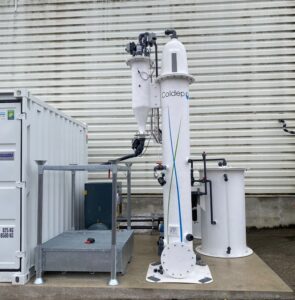
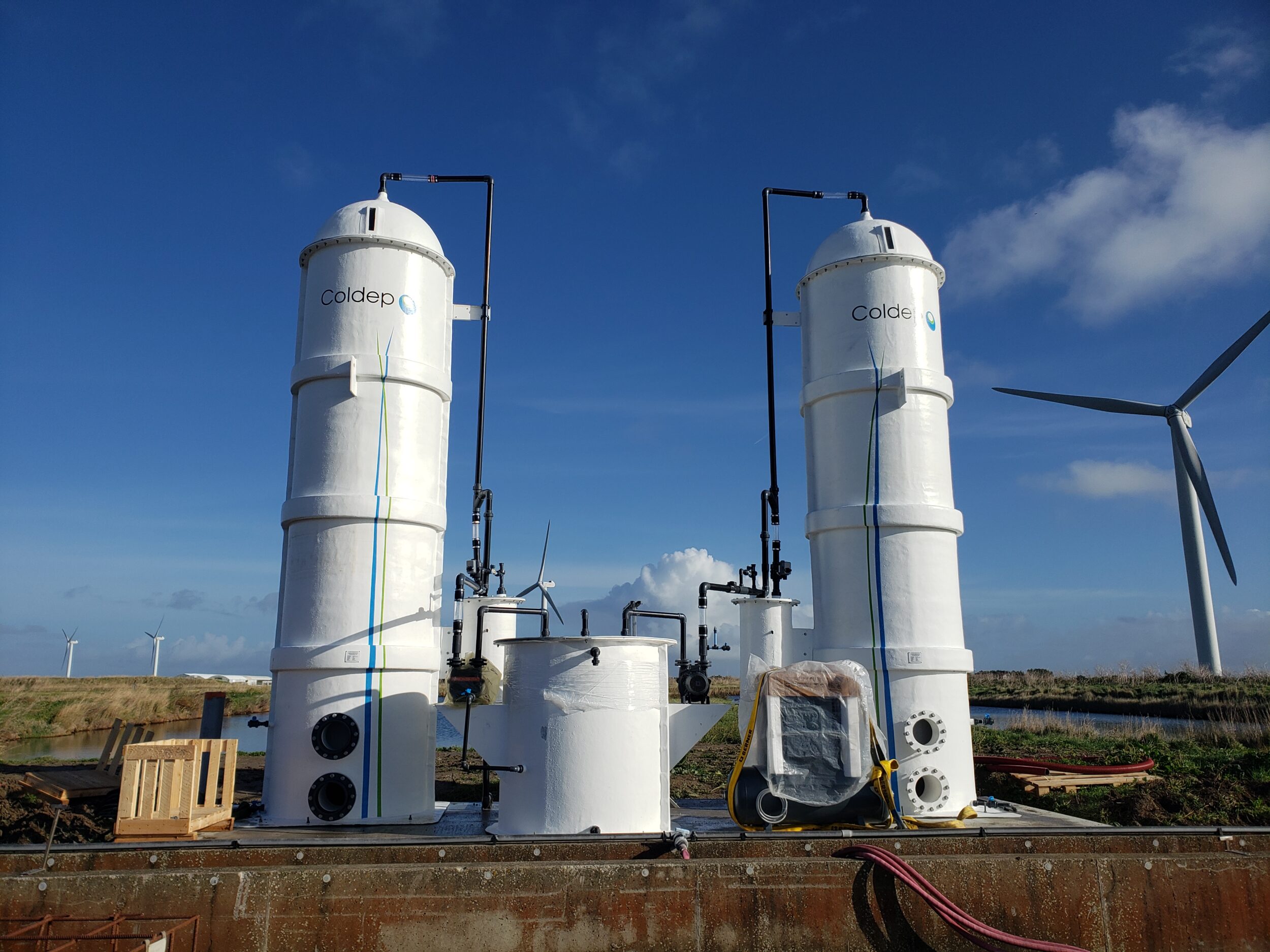
VAL uses a specially designed vertical column operated under partial vacuum. The reduced pressure creates very fine microbubbles that interact with suspended particles and bring them toward the top of the column, where they are concentrated into foam and extracted. At the same time, the airlift effect drives water circulation through the system.
The process
Water enters the vertical VAL column, where partial vacuum and controlled air injection generate microbubbles. These bubbles interact with suspended particles and carry them toward the top of the column, where they form a concentrated foam layer that can be removed.
The airlift effect also creates controlled water circulation through the column without requiring a conventional external circulation pump for the treatment process. Flow, air supply, vacuum level and other parameters can be adjusted according to the characteristics of the water and the required treatment performance.
Where required, the same column can also support gas exchange. Vacuum can help remove dissolved CO₂, N₂ and H₂S,, while controlled gas injection can be used to increase dissolved oxygen or introduce another gas.
Our positive impact
Efficient particle extraction
VAL generates fine microbubbles under vacuum, increasing the available surface area for particle capture. The particles are concentrated in a foam layer and extracted from the water without a filtration barrier. The technology can also be concentrate suspended particles significantly.
Low energy consumption
The VAL process combines treatment and water circulation while operating with low pressure loss.
Compact vertical design
The vertical configuration significantly reduces the required footprint compared with conventional horizontal treatment processes. A footprint of up to five times smaller than conventional DAF systems can help integrate treatment into space-constrained facilities.
Little or no chemical use
VAL is based on a physical separation process. VAL AQUA is designed to operate without additives, while VAL INDUS can use few or no consumables depending on the application and treatment target. this can reduce chemical handling and associated operating costs.
Reduced water loss
The free-flow design does not rely on membrane filtration and can therefore avoid the water losses associated with membrane concentrate streams.
One multifunctional process
particle extraction, water circulation and gas exchange can be combined within the same technology. This allows VAL to replace or simplify parts of a conventional treatment chain, depending on the application and required water quality.
VAL solutions
VAL INDUS
VAL INDUS is designed for industrial wastewater and effluent treatment. It can be used for particle extraction and can be combined with complementary treatment processes such as ozone, UV, activated carbon, biological treatment or nanofiltration when more advanced treatment target are required.
The VAL INDUS range include different column sizes, allowing systems to be configured for different flow requirements. Multiple units can be installed in parallel when higher capacities are required.
VAL AQUA
VAL AQUA is designed for water treatment applications including aquaculture, shellfish purification and public aquariums. In addition to particle extraction, it can provide dissolved gas management, including CO₂/N₂ degassing and oxygen dissolution.
The VAL AQUA range covers models from VAL 400 to VAL 2000, with maximum degassing ranging from 50 to 1,200 m³/h. Multiple units can be installed in parallel for higher flow rates.

Applications
VAL technology can be applied across a range of water treatment challenges, including:
- Industrial wastewater treatment
- Food and beverage wastewater
- Dairy wastewater
- Textile wastewater
- Sugar industry wastewater
- Chemical industry wastewater
- Water reuse pretreatment
- Aquaculture and recirculating aquaculture systems
- Shellfish purification
- Public aquariums
- Desalination pretreatment
- PFAS and micropollutant treatment
- CO₂ bioremediation
Flexible integration into your treatment process
VAL does not have to operate as a standalone solution. It can be integrated with other NSI technologies to create a treatment train tailored to your water quality and discharge or reuse requirements.
For example, VAL INDUS can be combined with ozone, UV, activated carbon, biological treatment or nanofiltration for tertiary or advanced treatment applications.
We can combine VAL with technologies across the NSI portfolio, including DAF, ion exchange, membranes and advanced oxidation.

Key figures
Up to 1,500 m³/h
Flow range
Up to 5× smaller than conventional DAF
Footprint
VAL 400–VAL 2000
VAL AQUA models
VAL 900–VAL 2000
VAL INDUS models
Did you know that VAL is also interesting for PFAS concentration?
References
- Industrial
- Fish processing
Foam fractionation for shellfish processing to reduce energy consumption – Guy Sanchez Huîtres
Oyster producer on the Étang de Thau in southern France, initially planned a conventional water-treatment train:
- Industrial
- Food & Beverage
Compact wastewater treatment for ready-meat manufacturer to meet discharge standards
A manufacturer of ready-made meals – notably tomato-based recipes – needed to treat a high-strength, high-pH industrial effluent to meet strict discharge standards, within a very limited ground footprint.
Contact our experts
Frequently asked questions
VAL stands for Vacuum Air Lift. It is a patented water treatment process that combines partial vacuum, flotation and airlift circulation to extract particles, move water and regulate dissolved gases.
VAL can extract suspended particles across a broad size range, including fine particles, bacteria, viruses and other suspended matter. Its performance depends on the water characteristics and the selected configuration.
VAL uses a vertical vacuum flotation process rather than conventional dissolved air flotation. Its design combines particle extraction and water circulation in a compact column, and it can also provide gas exchange. The supplied Coldep comparison reports a footprint up to five times smaller and energy consumption 3–5 times lower than the conventional processes included in its comparison.
Yes. VAL can be used as a pretreatment or treatment step for reuse applications, including in combination with membrane technologies. Its low water loss and particle extraction capabilities can support treatment trains where maximizing water recovery is important.
Yes. Vacuum can be used to degas water by reducing the concentration of dissolved gases such as CO₂, N₂ and H₂S. The process can also be configured for gas dissolution, including oxygen addition.