Your Challenges

Free oil removal
Condensate streams in refining processes often contain dispersed free oil droplets. Without reliable removal, downstream equipment performance and treated water quality can be negatively affected.
Protecting downstream carbon filters
Activated carbon filters are highly sensitive to oil loading. Elevated oil concentrations significantly reduce carbon media lifetime, leading to higher operating costs and unplanned downtime.
Managing solids contamination
Solids such as rust particles can damage oleophilic resin media. Without proper upstream protection, coalescer efficiency declines and overall system performance is reduced.
Your benefits

High‑efficiency removal of dispersed oil
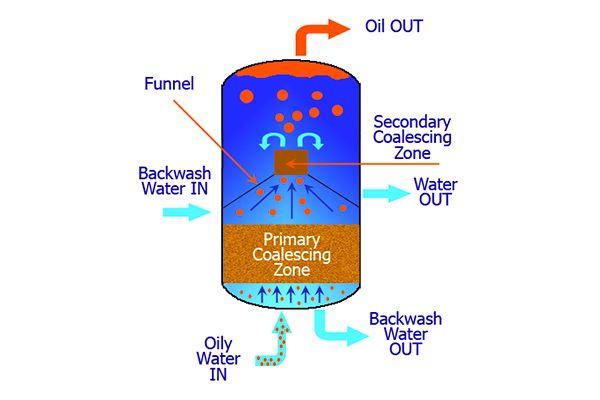
Condensate flows upward through an oleophilic resin layer, where oil droplets are attracted and retained until they form a film that detaches naturally. In the second oleophilic layer, droplets merge into larger drops, improving removal efficiency and delivering cleaner water with fewer operational interruptions.

Lower oil loading to protect activated carbon
NSI resin coalescers reduce oil concentrations from tens of milligrams per liter (up to 100 mg/L) to approximately 1 ppm. This significantly extends activated carbon lifetime and reduces maintenance frequency and operating costs.

A stable and complete solution
The coalescer is typically installed between a pre filter and an activated carbon filter. This step‑by‑step approach—solids removal, oil coalescence, and final polishing to ppb levels—forms a proven and reliable NSI condensate treatment solution.

Continuous, self‑regenerating performance
Oleophilic resin media releases oil films automatically once they reach a certain thickness. This self‑regenerating behavior keeps the coalescer active without frequent intervention, supporting predictable and stable performance.
The Process
Condensate enters the NSI resin coalescer and flows upward through the oleophilic resin layer. Oil droplets adhere to the beads, form a film, and detach when they grow large enough. In the second resin layer, droplets combine into larger drops that separate more easily.
A pre filter protects the resin from solids, while a downstream activated carbon filter captures the final traces of oil before discharge.
Applications
- CO₂ and oxygen removal for boiler feed water
- Oxygen removal for well water injection
- H₂S removal for waste stream decontamination
- BTEX stripping from produced water
All delivered as NSI degasification solutions.