Your challenges
Water utilities and industrial facilities need to remove micropollutants while keeping treatment sustainable, reliable and cost-effective. At the same time, water reuse applications place additional demands on the protection and performance of downstream membrane systems.
Increasing pressure to remove micropollutants
Conventional wastewater treatment does not remove all organic micropollutants, including pharmaceutical residues and other emerging contaminants. Utilities therefore need effective advanced treatment technologies that provide high removal performance without excessive energy and chemical consumption.
Protecting RO membranes from biofouling
Biofouling is a major challenge in reverse osmosis systems. Biodegradable organic compounds and other foulants in the RO feed can promote biological growth on the membrane surface, resulting in increased pressure, more frequent cleaning, higher chemical consumption and reduced membrane performance.
Reducing operating costs and environmental impact
Conventional granular activated carbon systems can require carbon replacement or regeneration. Water treatment operators are looking for alternatives that maintain effective micropollutant removal while reducing chemical use, waste generation, energy consumption and total cost of ownership.
Supporting sustainable water reuse
Water reuse projects require reliable treatment processes that can consistently deliver the required water quality. Treatment technologies need to be scalable and adaptable to different applications, from wastewater polishing and micropollutant removal to pretreatment for advanced water reuse and RO systems.
How does it work ?
The process
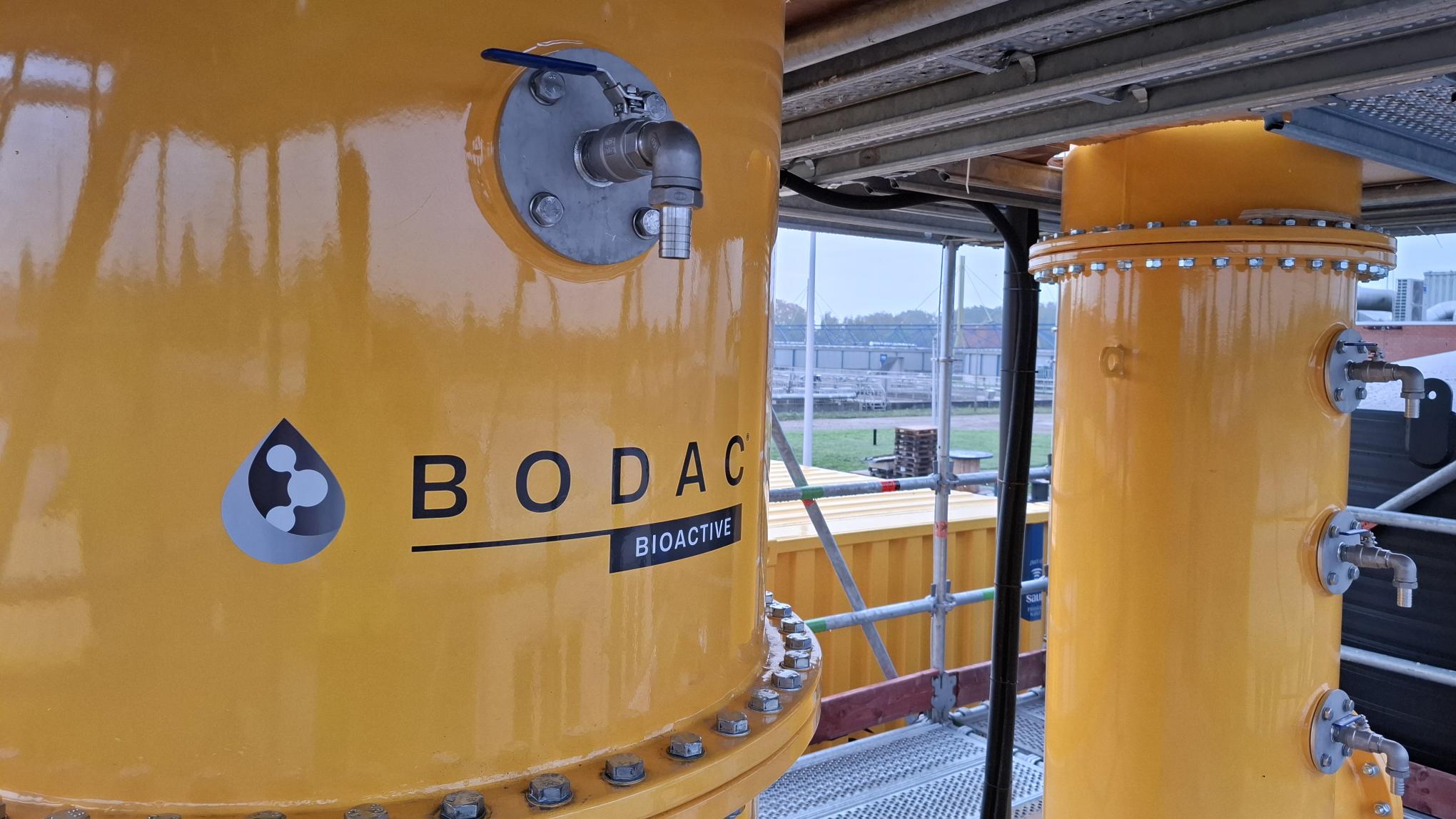
BODAC® combines biological activated carbon filtration, oxygen dosing and biological degradation in a single treatment process.
As water passes through the BODAC® filter bed, organic micropollutants are adsorbed onto the activated carbon while microorganisms growing on the carbon surface biologically degrade biodegradable compounds. This biological activity continuously regenerates part of the carbon’s adsorption capacity.
The result is a long-lasting treatment process that removes micropollutants while simultaneously reducing the organic load and biofouling potential of the treated water.
Specially developed carbon
BODAC® uses specially developed biological activated carbon operated under oxygen-rich conditions. As wastewater passes through the filter bed, micropollutants and organic compounds interact with the activated carbon surface.
At the same time, microorganisms growing on the carbon degrade biodegradable compounds. The combination of adsorption and biological degradation allows the carbon to maintain its treatment capacity over long operating periods.
Oxygen dosing supports the biological activity within the filter and contributes to stable treatment performance. Periodic backwashing maintains the appropriate biomass concentration and hydraulic performance of the filter.
The treated water contains significantly lower concentrations of organic micropollutants and a reduced biofouling potential. When BODAC® is installed upstream of RO, this provides additional protection for the membrane system and supports stable operation.
BODAC® performance can be monitored and controlled through the BODAC® Controller, which can be integrated with an existing SCADA system for process monitoring, control and data reporting.

Our positive impact
BODAC® combines proven micropollutant removal with biological regeneration, low chemical consumption and protection of downstream RO membranes.
Proven micropollutant removal
BODAC® consistently removes 70–90% of pharmaceutical residues and other organic micropollutants in proven full-scale applications. The technology combines adsorption and biological degradation to target contaminants that are not sufficiently removed by conventional wastewater treatment.
BODAC® has demonstrated stable performance over more than 15 years of full-scale operation, providing a proven approach to advanced micropollutant removal.
Maximum protection of RO membranes
When installed upstream of reverse osmosis, BODAC® reduces the biodegradable organic load and biofouling potential of the RO feed water. This supports more stable membrane operation, reduces cleaning requirements and can extend membrane service life.
Proven applications have demonstrated RO membrane lifetimes exceeding ten years, providing an important contribution to reliable and cost-effective water reuse.
Reduced chemical consumption and operating costs
The biological process reduces the need for chemicals and biocides compared with conventional treatment approaches. BODAC® can reduce chemical consumption by up to 90% in proven applications.
Combined with reduced maintenance, longer RO membrane lifetime and the elimination of routine carbon replacement, this can significantly reduce the total cost of ownership.
Lower carbon footprint and enhanced sustainability
Unlike conventional activated carbon systems that rely on periodic carbon replacement or thermal regeneration, BODAC® uses biological activity to continuously regenerate the activated carbon within the filter.
This reduces the need for carbon replacement and associated waste, while lowering energy consumption and the environmental impact of the treatment process.

Key figures
70–90%
removal of pharmaceutical residues and other organic micropollutants.
Up to 90%
reduction in chemical and biocide consumption in proven applications.
>200,000 bed volumes
treated in proven applications.
>10 years
RO membrane lifetime demonstrated in proven applications.
"BODAC® combines biological regeneration, micropollutant removal and RO membrane protection in a single sustainable solution. The result is maximum purification with minimal emissions, minimal maintenance and long-term operational reliability. "
Contact our experts
Frequently asked questions
BODAC® is a biological activated carbon filtration technology that combines adsorption and biological degradation for advanced water treatment. It is designed to remove organic micropollutants, including pharmaceutical residues, while also reducing the biofouling potential of water supplied to downstream reverse osmosis systems.
BODAC® has demonstrated consistent removal of 70–90% of pharmaceutical residues and other organic micropollutants in proven full-scale applications. Actual removal performance depends on the water quality, target compounds, filter design and operating conditions.
Micropollutants are initially adsorbed onto the activated carbon. At the same time, microorganisms growing on the carbon surface biologically degrade biodegradable compounds. This combination of adsorption and biodegradation enables long-term micropollutant removal and helps maintain the treatment capacity of the carbon.
No routine carbon replacement or thermal regeneration is required. Biological activity within the filter continuously regenerates part of the activated carbon's adsorption capacity, allowing long-term operation without conventional carbon replacement.
BODAC® removes biodegradable organic compounds and other foulants that can contribute to biological growth on RO membranes. By reducing the biofouling potential of the RO feed water, BODAC® supports stable membrane operation, reduces cleaning requirements and can extend membrane service life.
Yes. BODAC® has a modular design that allows integration into both new and existing treatment facilities. It can be applied as a polishing step for micropollutant removal or as pretreatment upstream of reverse osmosis systems.
BODAC® can be used as an advanced polishing treatment for organic micropollutant removal from wastewater effluent. Recent full-scale and pilot research on BODAC® filters has demonstrated high removal of target organic micropollutants and investigated the technology specifically in the context of the recast UWWTD and quaternary treatment.
The BODAC® Controller monitors and optimizes filter performance and can be integrated with an existing SCADA platform. This enables process monitoring, control and data reporting as part of the wider treatment plant automation system.
Yes. Nijhuis Ozone solutions can be integrated with complementary technologies such as activated carbon, BODAC®, filtration, biological polishing and membrane treatment. Combining technologies can provide a tailored treatment train where specific water quality targets or contaminant groups require additional treatment.