
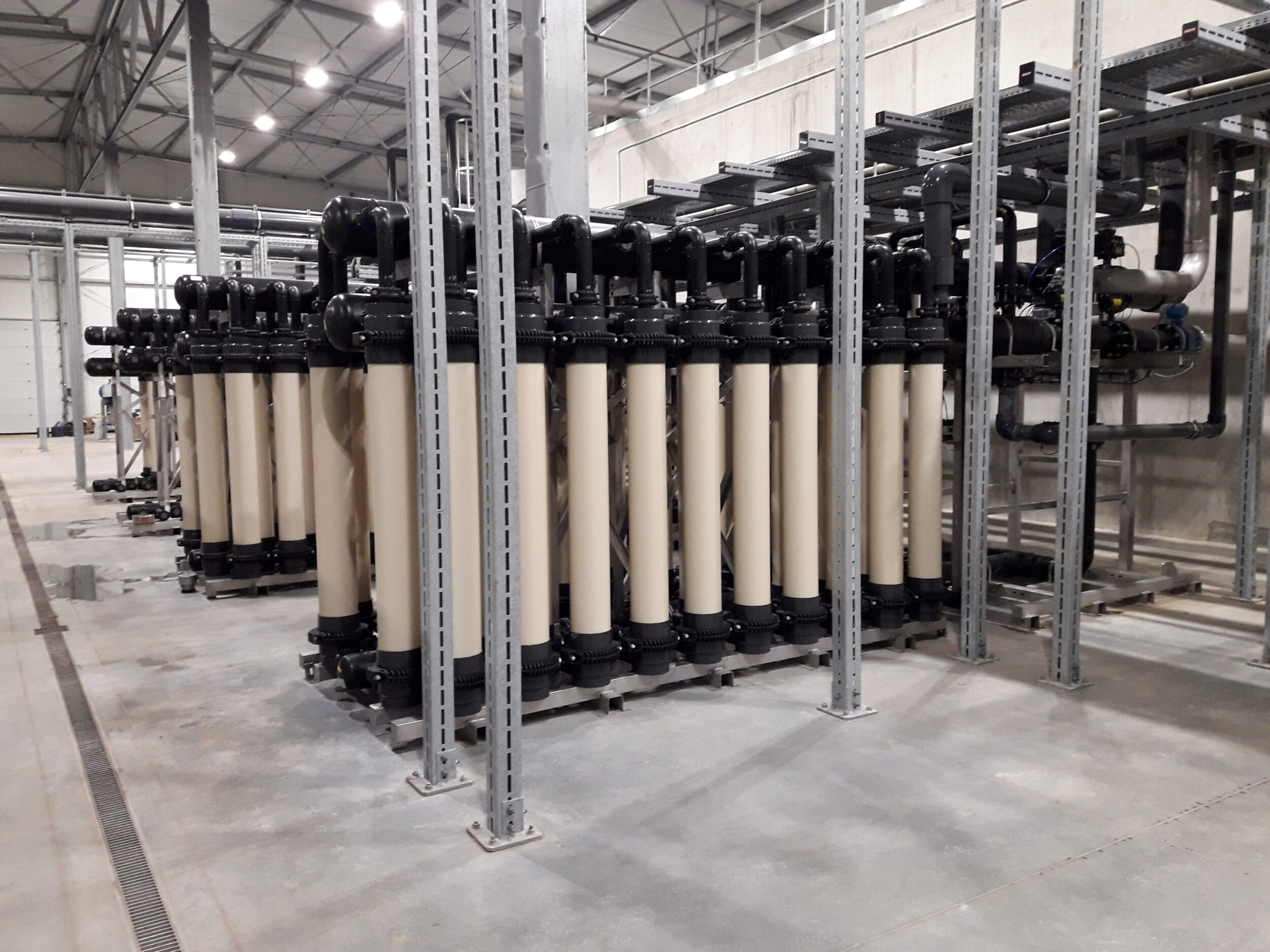
Your challenges
Suspended solids, microorganisms, changing flow rates, and demanding reuse requirements can make it difficult to maintain stable water quality while keeping treatment efficient.

Variable water quality and flow
Changes in feedwater quality and flow can affect treatment performance and downstream processes. A flexible ultrafiltration solution is needed to maintain reliable separation under changing operating conditions.

Protecting downstream membrane processes
Reverse osmosis and nanofiltration require effective pretreatment to maintain stable operation and reduce membrane fouling. UF can provide a strong barrier before these processes, helping create a more reliable overall treatment train.

Increasing water reuse requirements
Industries are looking for ways to reuse more water and reduce their dependence on freshwater. This requires treatment solutions that can produce consistent water quality while fitting into existing or new water reuse schemes.

Capacity and future expansion
Water demand can change over time, from smaller decentralized applications to large industrial facilities. A modular approach allows the treatment capacity to match the application and create opportunities for future expansion.
How does it work ?
Key figures
Dead-end or cross-flow
Operating modes
3-2,000 m³/h
Capacity range
Up to >90%, depending on application and operating conditions
Recovery
References

- Industrial
- Food & Beverage
- Waste-To-Energy
Wastewater treatment and biogas production for poultry processing – Cedrob
Context
Cedrob S.A., a leading and fast-growing poultry producer in Poland, is expanding its slaughtering operations while aiming to minimize environmental impact and secure long-term water availability. Due to site development by extra slaughterlines and rendering facility as well as climate-related pressure on local groundwater resources, additional freshwater abstraction became restricted. At the same time, Cedrob sought to increase production without increasing its environmental footprint.
In partnership with Nijhuis Saur Industries, Cedrob therefore developed an integrated and sustainable water management strategy combining wastewater treatment, water reuse, and waste-to-energy. The objective was to ensure reliable internal water supply, minimize discharge and disposal, and convert organic residues into renewable energy. Today, more than 50 % of the site’s water demand is covered by reclaimed process water.

- Energy
Water reuse and biogas production for industrial operations to reduce dependance on drinking water – DWD Delfzijl
Context
Duurzame Watervoorziening Delfzijl (DWD) is a landmark project in the Netherlands, enabling large-scale industrial transition to alternative water sources. Led by North Water, the initiative provides industrial water from surface water via a treatment facility in Garmerwolde. Nijhuis Saur Industries (NSI) and Econvert Water & Energy contributed significantly with an anaerobic wastewater treatment system and a modular demineralized water (demiwater) installation. The project addresses the growing pressure on drinking water resources and supports sustainable industrial operations in Delfzijl
Solution
NSI and Econvert delivered a comprehensive solution including anaerobic wastewater treatment and a modular demiwater installation. The demiwater system upgrades industrial water to ultrapure quality (<1 µS/cm), suitable for boiler feed and green hydrogen production. The modular setup includes separate containers for UF, RO, membrane degassing, and EDI, allowing off-site construction and rapid deployment. The Econvert-EGSB® treats high-organic wastewater, producing biogas that is desulfurized using Econvert-Dsulph® technology. The biogas is upgraded for use as green gas. The system is designed for scalability and future industrial expansion.

- Industrial
- Pharma & personal care
Water reuse for personal care manufacturing to reduce water consumption – L’Oréal
Context
As part of its global sustainability initiative “Sharing Beauty with All”, L’Oréal committed to reducing water consumption, waste output, and CO₂ emissions by 60% compared to 2005 levels. At its Warsaw plant, the challenge was to implement a water recycling system that could recover high-quality water for reuse in production processes, while also showcasing environmental leadership. The project needed to ensure continuous water availability, operational safety, and long-term reliability.
Solution
Nijhuis Saur Industries designed and built a Water Recycling Station using a combination of physical-chemical pretreatment, biological treatment with MBR, ultrafiltration, and reverse osmosis. The system includes the i-DOSE intelligent dosing system for optimized chemical use and online chloride monitoring to manage recovery rates. The plant is fully automated and integrated into the factory’s operations, with a modern design that fits the site’s aesthetics.