
Cleaning is the most water-intensive process in a food and beverage plant, accounting for as much as 70 per cent of its demand, and it is the main route by which pollutants enter water. Many of them survive conventional treatment and build up in rivers and soils, with consequences for biodiversity and health.
The project will combine multimodal sensors and artificial intelligence models to detect the pollutants in real time, alongside circular treatment technologies. The solutions will be validated under real industrial conditions in three key sectors: meat, fruit juice and confectionery.
With a budget of nearly €6.8 million from the Horizon Europe programme, the consortium expects to achieve reductions of between 40 and 80 per cent in pollutants at the pilot plants where the innovations will be validated. The initiative is also seeking to achieve a removal efficiency of more than 75 per cent, as well as to reuse over 50 per cent of the treated water and recover more than 30 per cent of salts and reagents.
One of the project’s scientific cornerstones “is what is known as the ‘cocktail effect’”, explains the project’s principal investigator, Andrea Naves, of Eurecat’s Water, Air and Soil Unit — that is, “simultaneous exposure to a range of pollutants which, once mixed, can amplify their impact on the environment and on health. EmerGO therefore takes these cumulative effects and human exposure into account in order to steer the most efficient treatment strategies”.
The solutions developed in the project aim to inform the future European rules governing pollution in the sector and will include transparency tools for consumers. “We want EmerGO to have a real impact, with technologies for industry, knowledge for regulators and clear information for consumers”, says the project coordinator at Eurecat, Óscar Rodríguez.
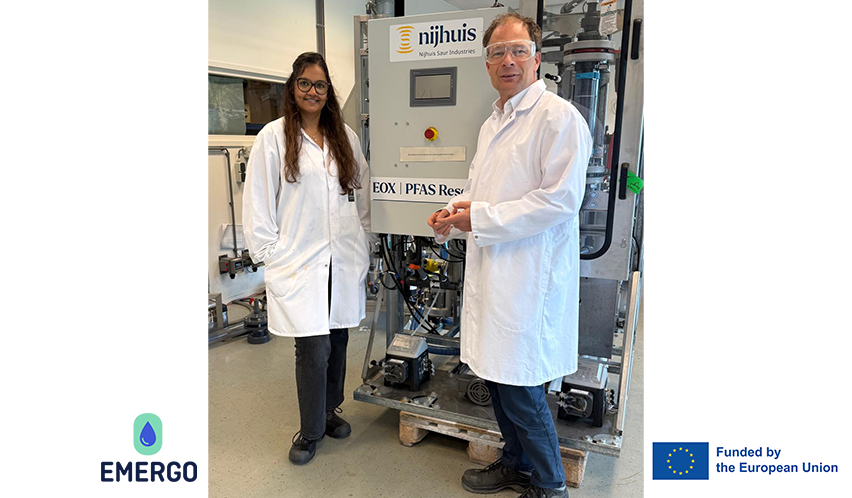
Saur Group, through its Nijhuis Saur Industries business unit, is proud to be part of EmerGO, a Horizon Europe project addressing persistent and emerging pollutants in wastewater generated by cleaning processes in the food and drink industry.
As part of the consortium, Nijhuis Saur Industries will contribute its industrial water and wastewater treatment expertise to the development and validation of monitoring and treatment solutions under real operating conditions.
EmerGO brings together research organisations, technology providers and industrial partners to address pollutants including PFAS, microplastics and other substances of concern. The project aims to help translate research into practical approaches for the sector, taking account of operational, environmental and economic requirements.
“Persistent and emerging pollutants require more than scientific innovation: solutions must also be tested in real industrial environments. Through EmerGO, Nijhuis Saur Industries will contribute its industrial water treatment expertise to help develop and validate practical approaches for the food and drink sector, supporting more resilient and sustainable water management.”
Wouter Noordman
Director Group R&D, Saur