
Your Challenges
Growing Water Scarcity & Climate Impacts
Changing rainfall patterns and regional water stress create uncertainty in water availability. Many facilities face regulatory pressure to improve responsible water use, secure permits, and demonstrate sustainability commitments.
Limited Visibility of Current Water Consumption
Most sites lack a clear understanding of their real water balance, how water moves through production, where it is consumed, and which processes account for major usage. Without a full picture, opportunities for reduction or reuse remain hidden.
Need to Reduce Freshwater Demand & Wastewater Volumes
Industries must lower water abstraction, reduce effluent generation, and find alternative water sources. Achieving this requires technical insights, economic feasibility analysis, and specialized assessment of reduction, reuse, recycle, and reclaim options.
How we help you ?
Clear Understanding of Water Balance
We assess your entire water system—including key water users (those above 5% consumption), treatment units, sewer plans, and P&IDs. Through audits, data review, and sampling campaigns, we provide a clear, factual water balance that forms the basis for optimization.
Identification of Reduction, Reuse, Recycle & Reclaim Opportunities
Using the established water balance, we evaluate where water savings can be achieved. Opportunities include process reductions, direct reuse between process steps, internal recycling through treatment, and full‑scale reclaim for utility use.
Practical, Actionable Interventions
We deliver interventions that vary from simple operational adjustments (e.g., optimized backwash cycles, automated shut-off valves) to redesigns such as CIP rinse reuse, sand filter backwash recovery, or full effluent reclaim. Each intervention includes estimated savings, ROI, and implementation recommendations.
Technical & Economic Feasibility Support
Our consultancy provides savings estimates, footprint requirements, CAPEX/OPEX evaluation, and supporting documentation for senior management. Where required, we perform bench or pilot testing to validate results and ensure confidence before implementation.
Our Process
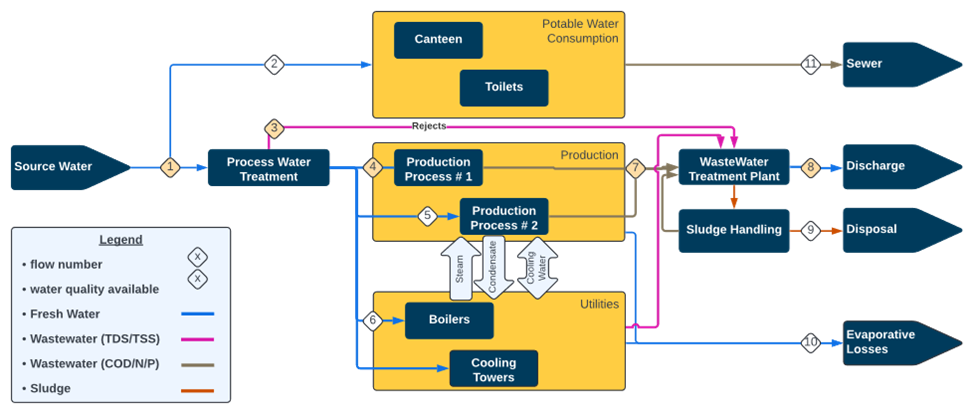
Our process begins by establishing a complete and accurate water balance for the site, recognizing that water usage changes across seasons, production schedules, and system modifications. We start by identifying key water users—those consuming more than 5% of total water—and mapping all relevant treatment and utility systems. Using this information, we build a clear water flow chart that visualizes the site’s current water pathways and consumption patterns.
To deepen the analysis, we conduct comprehensive water audits and review existing engineering documentation such as Process Flow Diagrams (PFDs), Piping and Instrumentation Diagrams (P&IDs), and sewer plans. We evaluate available water quality and quantity data to understand variability and operational impacts. When required, we perform on‑site sampling and analysis campaigns to gather missing information and validate assumptions. This structured approach results in a detailed, data‑driven water balance that forms the foundation for identifying reduction, reuse, recycle, and reclaim opportunities.
Frequently Asked Questions
To identify where water is consumed, highlight opportunities for reduction and reuse, and develop a technical and economically feasible plan to minimize freshwater use and wastewater volumes.
We do both. We analyze the full water system and provide reduction, reuse, recycle, and reclaim solutions aligned with operational and financial goals.
Yes , With NSI’s technology portfolio and engineering capabilities, we can support concept development, pilot testing, and implementation of selected water‑saving solutions.