
Climate change is causing declining groundwater levels due to persistent drought. This water scarcity forces the Netherlands to make a fundamental shift in how it views water. Instead of the linear model — use and discard — a transition is needed to circular water management. In this, sewage treatment plays a crucial role. The effluent of sewage treatment plants (WWTPs) should no longer be treated as wastewater, but as a valuable resource that can be reused for drinking water production, industrial processes, or irrigation.
Circular water means that every drop is used multiple times before it returns to the natural water cycle. For the Netherlands, with its high population density and intensive industry, this is not a luxury but a necessity for a sustainable water supply. The transition to circular water management is therefore not only a technological challenge, but an economic and societal priority that determines whether the Netherlands can maintain its position as a prosperous water country in the future.
NieuWater, a subsidiary of Waterschap Vechtstromen, has been producing “ultrapure water” from the effluent of the WWTP in Emmen since 2010. This Ultra Pure Water Factory (UPW) was preceded by an extensive study with pilot tests, to arrive at a total design with minimal use of chemicals and a limited residual stream that can be returned directly to the WWTP. This has resulted in a design for which there is increasing worldwide interest. NieuWater regularly receives visitors from all over the world, in recent years including from Denmark, Germany, Saudi Arabia, the United States, Vietnam, and South Korea.
In 2019, after almost ten years of experience, this plant was already described [1]. This article goes deeper into the quantitative aspects of the UPW and the latest developments.
Design
The UPW is designed to continuously produce 8,200 m³ of ultrapure water per day, with a maximum of 10,000 m³/day. For this, 11,000 to 13,500 m³ of effluent per day is required.
The WWTP in Emmen processes daily between 15,000 and 125,000 m³ of wastewater — comparable to the domestic wastewater of 200,000 people. In the Emmen region, relatively much rainwater is discharged via the sewer system. This explains the wide bandwidth in the daily inflow of sewage water. If, after a period of drought, a heavy rain shower occurs, this leads to an extreme load on the treatment with sludge from the sewers and a short period of high ammonium concentrations and sludge in the effluent. The UPW can cope with these conditions without problems.
The practical experience of fifteen years of reuse proves that WWTP effluent is excellently suited as a source for industrial water, particularly in regions where water scarcity forms a structural problem.
Limitation of residual streams
The main treatment of WWTP Emmen consists of ultrafiltration (UF) for the removal of non-dissolved substances and double reverse osmosis (RO) for the removal of salts and organic substances. The final step is electro-deionization (EDI), with which the last remnants of salt are removed from the water.
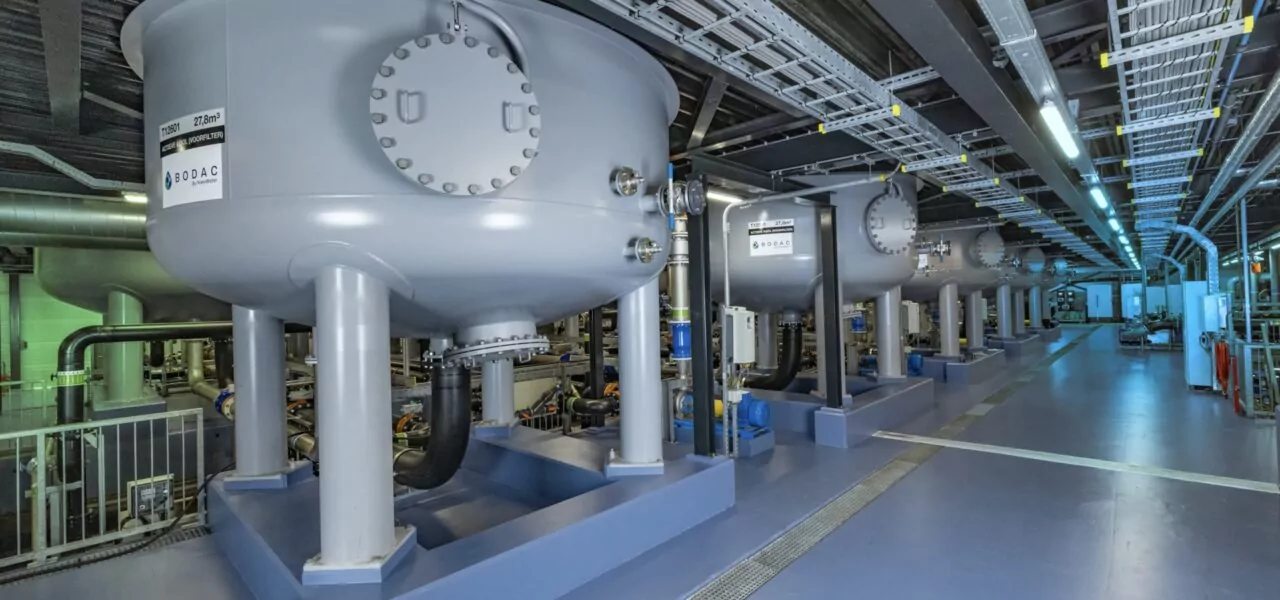
The WWTP effluent contains relatively many nutrients, which can lead to uncontrolled growth of bacteria on the RO membranes (biofouling). As an alternative to the use of biocides, the most commonly applied method to prevent this, BODAC was developed. In this technique, a filter with activated carbon is applied with an additional dosing of oxygen and specific control technology. During a PhD study [2] it was demonstrated that this technique not only prevents biofouling, but also other forms of membrane fouling. The activated carbon is not replaced or regenerated and has now also been operating for fifteen years. With application of BODAC, the RO membranes only need to be cleaned twice per year (preventively) with hydrochloric acid and sodium hydroxide. Normally this occurs at least twice as often.
In RO, antiscalants are generally dosed. These are substances that prevent salts from precipitating (scaling) during concentration of the water. At NieuWater, special in-line monitors are installed that directly detect both biofouling and scaling. This enables NieuWater to limit the amount of antiscalant in the ROs to a minimum (approx. 10 percent of the usual amount).
Through these techniques, NieuWater is able to limit its waste streams both qualitatively and quantitatively. The following residual streams are returned to the WWTP:
- concentrate from the UF, which consists of sludge from the WWTP. By sending this back to the inlet of the WWTP, even the load of surface water with sludge from the WWTP discharge is reduced;
- backwash water of filters: filters are regularly backwashed to remove excess biology (particularly nitrifiers). The backwash water contains many useful bacteria for the WWTP;
- concentrate from the ROs. This mainly contains salt and organic compounds (e.g. humic acids). The salt has little influence on the quality of the WWTP water, given the large contribution of rainwater. In dry periods (summer), the surface water originates from Lake IJsselmeer and contains relatively much salt compared to WWTP effluent. BODAC has already removed many pharmaceutical residues and other contaminants from the water, so that this return water has no adverse influence on the treatment process in the WWTP as a result of dilution or accumulation of components in the biology.
These residual streams contain far fewer contaminants than the other incoming sewage water.
Long membrane lifetime
As stated, the UF and RO membranes are now fifteen years old and have not yet been replaced. The UF membranes are relatively lightly loaded compared with, for example, a membrane bioreactor (MBR) for which they were designed.
The reason for the long lifetime of the RO membranes is twofold: with BODAC, less fouling occurs than with the regular techniques to prevent biofouling. As described, the membranes are cleaned relatively little with chemicals. It is important here that the production of the UPW is on average lower than the design capacity. Moreover, the capacity is based on the use of four of the five trains. Calculations show that during these fifteen years the membranes were in production on average approximately half of the time.
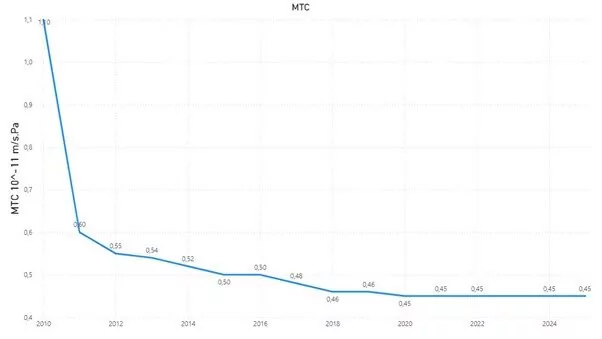
Figure 1. MTC values of the first RO stage in 15 years of operation
However, we do see a strong decrease in the initial period. The mass transfer coefficient (MTC) decreases from 1.1·10⁻¹¹ m/s·Pa to 0.5·10⁻¹¹ m/s·Pa in just over one year (see Figure 1). Research has shown that this may be caused by polyelectrolytes that were applied in sludge thickening at the WWTP. Further research into the cause is currently ongoing. After the first strong decrease, the MTC decreases very slowly (approx. 0.5·10⁻¹¹ m/s·Pa in ten years).
The ultimate water factory
Drinking water companies, water authorities, STOWA and KWR, in total fourteen partners, are collaborating in the project “The Ultimate Water Factory” [3] to investigate whether WWTP effluent could in the future be a source for drinking water. One of the components of this project is a demonstration installation at the UPW in Emmen. Here it is investigated which treatment steps are minimally necessary to produce guaranteed (chemically and biologically) reliable drinking water. As a project partner, NieuWater supplies the demo installation to make drinking water from ultrapure water and facilitates the research.
Further development of BODAC
In 2018, further investigation into the operation of BODAC showed that these filters are excellently capable of removing pharmaceutical residues and other organic compounds (through degradation) [4]. After this discovery, NieuWater conducted research into direct application of BODAC as a fourth treatment stage for removal of pharmaceutical residues. This proved to be very well possible [5].
From this research and comparison with other techniques, BODAC emerges as a relatively inexpensive technique with a small CO₂ footprint, particularly because the activated carbon does not need to be replaced or regenerated. The BODAC concept is patented, and the name and logo are registered.
All tests with BODAC were initially carried out on the effluent of the WWTP in Emmen. In addition to pharmaceutical residues and other microcontaminants, BODAC also removes ammonium (see Figure 2) and manganese.
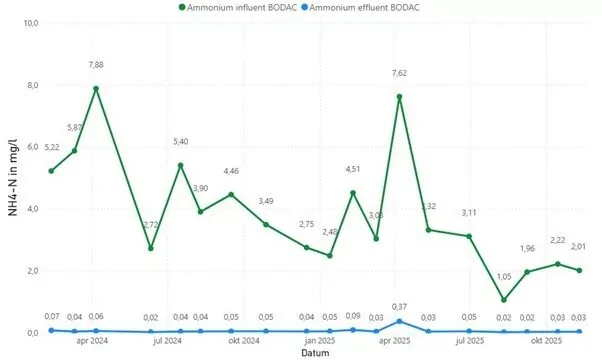
Figure 2. Removal of ammonium by BODAC during the period of testing with iron dosing and unpressurized operation
The question is whether BODAC gives comparable results on other effluents. This was investigated at two locations:
- Horstermeer. Here Haskoning conducted research into the BO3 concept (later renamed Aurea). For this, BODAC carbon from the NieuWater installation was used [6]. The results proved comparable with the results in Emmen.
• Garmerwolde. At WWTP Garmerwolde, the Regain project was carried out, in which multiple techniques for removal of pharmaceutical residues are compared at pilot scale. Here too, the NieuWater pilot filled with BODAC carbon was part of the research. Here as well, the removal percentages proved comparable with the results achieved in Emmen.
Given the interest from water authorities and companies in this concept, NieuWater has granted licences for this technology to Nijhuis Saur Industries and Jotem Waterbehandeling to make this technology suitable for the market.
At the same time, the technology is further developed together with the mentioned parties, who contribute their practical knowledge. Attention is mainly paid to further reducing energy consumption and broadening the possible designs.
This has led to the following:
- Optimisation of the oxygen introduction system (patent applied for), enabling the BODAC filter to operate without overpressure. This leads to considerable energy savings. In the BODAC at the UPW, closed filters are applied that operate with an overpressure of approx. 1.5 bar. In the pilot research, STOWA [5] still assumed this 1.5 bar overpressure in the calculations, although this is no longer necessary.
- Combining BODAC with phosphate removal by dosing a coagulant (iron chloride). The removal of pharmaceutical residues proves not to be adversely affected. In Figure 3, pharmaceutical removal is shown in the period with phosphate removal and pressureless operation. These efficiencies exclude the removal efficiencies of the WWTP. If these are included, the total efficiency increases by approx. 10–15 percent.
- Introduction of BODAC BioActive Carbon. In 2025, NieuWater developed a new activated carbon. This is a seeded activated carbon, adapted to the organic microcontaminants, making it immediately effective and thus an important acceleration of the process. BioActive Carbon is applied in all new BODAC installations.
- Combination with ozone. Nijhuis Saur Industries is researching the combination of BODAC with their Ozone Strong Water (OSW) concept, with which pharmaceutical residues are removed even more extensively. With this addition, BODAC-OSW is ready to meet the strict future requirements for pharmaceutical removal from WWTP effluent. Through the combination of ozone and BODAC, ozone dosing can be reduced to prevent bromate formation.
- Exploration of AOP technology (UV-peroxide, Van Remmen UV Technology) with BODAC to inactivate, in addition to extra pharmaceutical residues, antibiotic-resistant bacteria (disinfection step). E. coli and related bacteria are also inactivated. By combining these two technologies, the UV dose can be strongly reduced, creating efficient treatment even at low transmission values (poor transmittance of the water for UV light).
Through the new oxygen introduction system and a pressureless filter, the possibilities for material selection have expanded. Larger installations in particular can also be built in concrete. This leads to both lower investment (capex) and maintenance costs (opex). As a result, the CO₂ footprint is also smaller than in the original design. Energy consumption has been reduced from approx. 0.13 to 0.05–0.07 kWh/m³. A first calculation shows that the costs per m³ are lower than mentioned in the STOWA report [5], despite the meanwhile strongly increased costs for materials and labour.
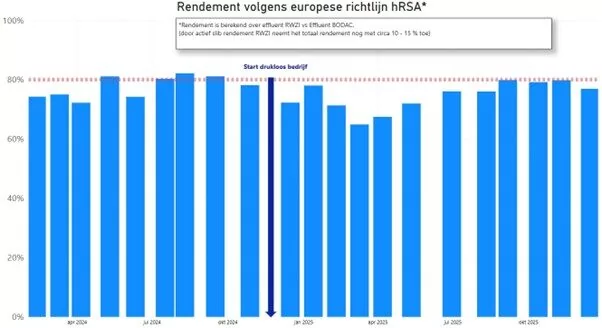
Figure 3. Efficiency of drug removal by BODAC with iron dosing for phosphate removal and pressureless operation
Dealing with lower analytical limits
Removal efficiency is determined by comparing the concentration in the influent and effluent streams. When the concentration of a certain substance is relatively low and close to the lower analytical limit, the concentration in the effluent will soon be lower than this limit. In that case, the value of the lower analytical limit must be used. As a result, a substance can never be shown to be removed 100 percent by this method. At low concentrations, this can have a large influence on the measured removal efficiencies.
Conclusion
With self-developed techniques, in combination with commercially available membrane techniques, NieuWater has delivered high-quality water for fifteen years. Membranes have never been replaced, chemical use is minimal, and all waste streams return to the WWTP. This results in a slight load on the WWTP from the salt in the RO concentrate. All other return streams are beneficial for the WWTP.
The spin-off of this plant is large: the BODAC technology can be widely applied as a fourth treatment stage for a WWTP that removes pharmaceutical residues and other contaminants. In addition, this technology is extremely suitable for the purpose for which it was developed: preventing both biological and chemical membrane fouling.
Summary
NieuWater now has fifteen years of experience with large-scale reuse of the effluent of the sewage treatment plant in Emmen. To prevent biofouling on reverse-osmosis membranes, the BODAC technology was developed. It proves excellently capable of removing pharmaceutical residues and other microcontaminants from effluent. Thanks to further research and development, this technology delivers good performance at relatively low energy consumption, optionally in combination with other techniques.