Project's context & challenges
The client is a leading multinational automotive manufacturer, active across multiple brands and markets worldwide. The company operates several large-scale production facilities in Central Europe and continuously invests in the expansion and modernization of its manufacturing footprint.
One of the company’s major automotive manufacturing plants in Central Europe runs a high-capacity production line with continuous operations and a large on-site workforce, supported by multiple external service providers. As part of a broader modernization program, the site required an upgrade of its existing wastewater treatment plant (WWTP) to align with current and future production demands, environmental regulations, and operational reliability requirements.
An international engineering and project management firm was appointed as overall project coordinator for the modernization program. Based on a proven track record of successful collaboration, Nijhuis Saur Industries Central Europe was invited to participate in the tender for the WWTP and water treatment plant (WTP) scope.
Following several technical and commercial alignment sessions, Nijhuis Saur Industries was awarded the contract to modernize the WWTP. The project includes the installation of a temporary rental treatment unit to ensure uninterrupted wastewater treatment operations during the transition phase, prior to commissioning of the permanent upgraded system.
Customer benefits
Optimization of the real operating cost of the system (chemicals, power consumption, etc.)
Rental solutions are based on a ‘plug and play’ principle, helping to achieve the ever demanding sustainable requirements
Optimized system to fulfil technological requirements
Solution
Along with NSI Global Office and local sub-suppliers, NSI CE has developed a winning conceptual solution for the WWTP modernization. Based on this concept, an offer has been prepared for the wastewater treatment plant in the“technological turnkey format.”
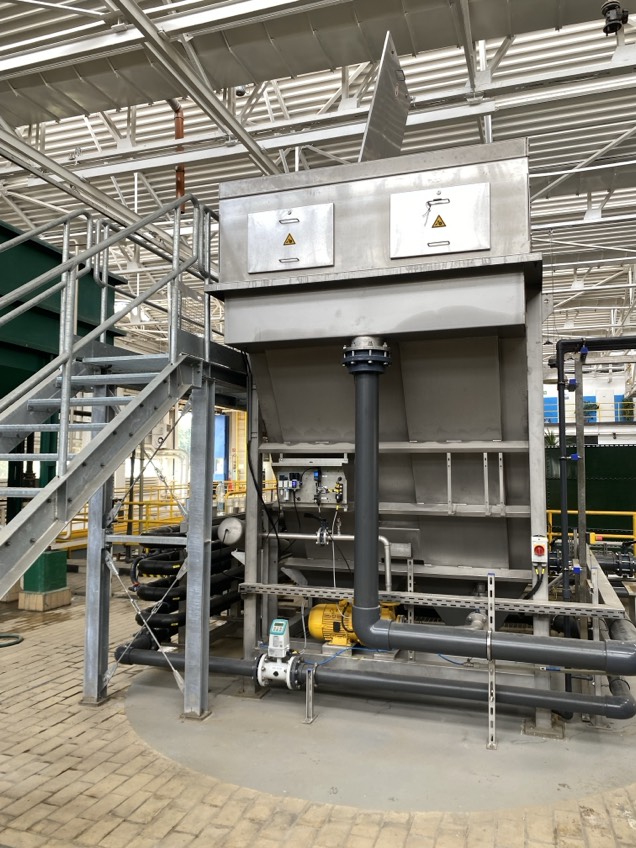
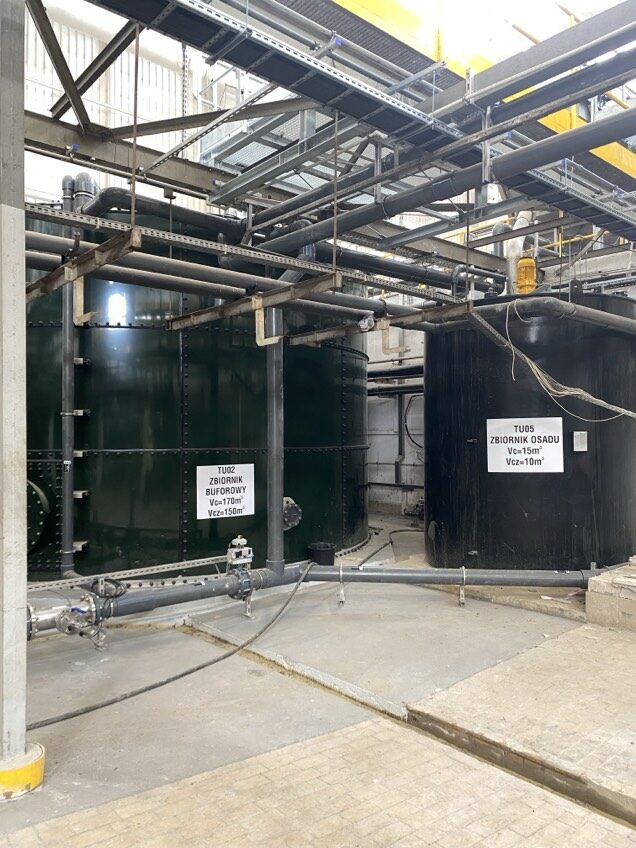
Nine different sources, primarily the paint shop, will contribute production wastewater. The system will direct this wastewater into two buffer tanks, separating it based on pollution levels. After equalization, the flow from the phosphating and optionally degreasing streams will move to a flocculation-flotation system. This stage will significantly reduce insoluble pollutants. Operators will add Fe(III), caustic/SAX, and anion PE to trigger co-precipitation of metals.
The process will maintain a pH of 6.5–7.0 for metal separation. However, not all metal hydroxides will reach sufficient insolubility at this range. In such cases, operators will add an additional precipitating agent to meet discharge requirements. After coagulation and metal precipitation, the system will proceed with flocculation and flotation.
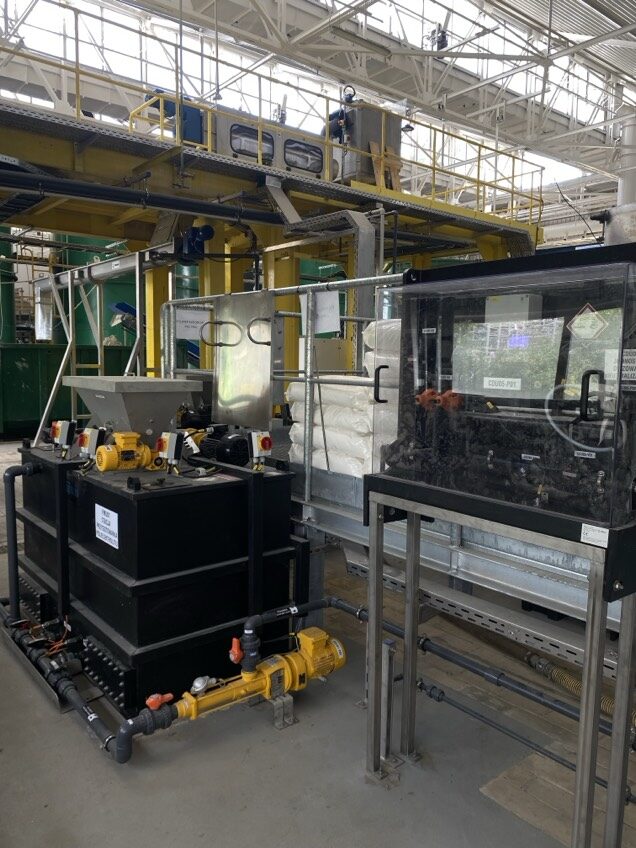
To minimize sludge volume destined for disposal, the setup includes a sludge dewatering system based on a screw press.

Scope of supply
- Rental of IPF semi containerised system based on flocculation-flotation.
Added value services
- Installation works on site
- Comissioning
- Start-up and training of operators
- Project Management
- Engineering
- Manuals