
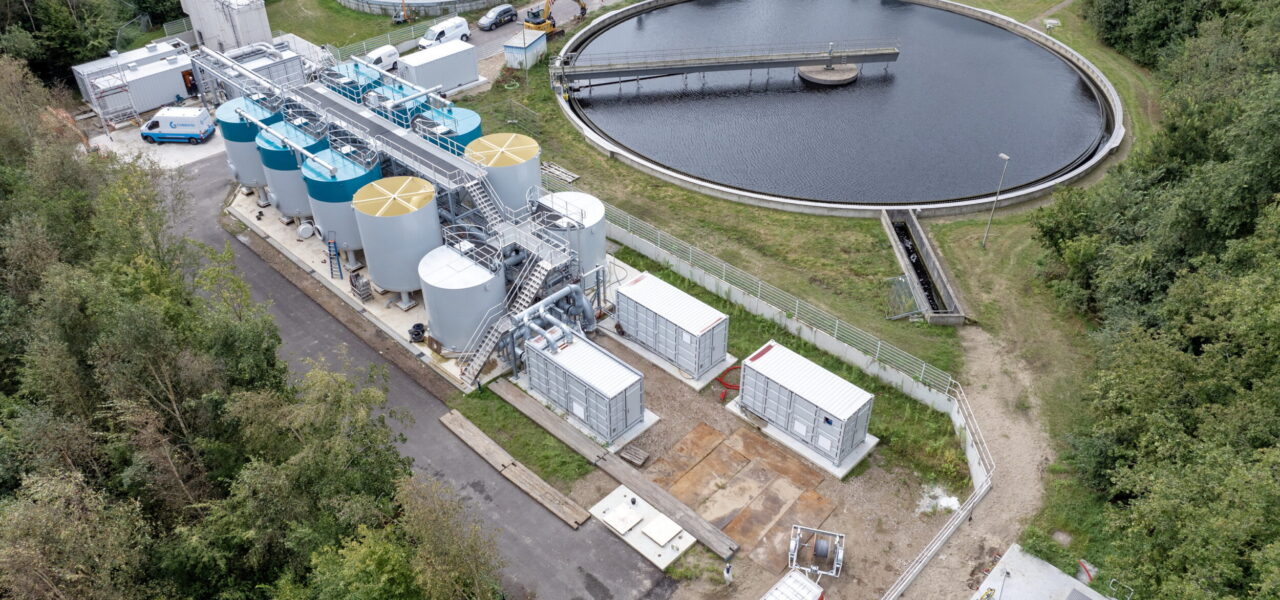
Water Authority Rijn and IJssel (WRIJ) has, for the third planning period of the WFD, the task of removing nutrients to an advanced degree in order to reduce the load from four WWTPs to surface water. One of these WWTPs is WWTP Winterswijk, which discharges into the Groenlose Slinge, a permanently flowing lowland stream in which special and vulnerable species occur. The WWTP must remove more phosphorus and ammonium and ensure a minimum oxygen concentration in order to be able to guarantee healthy water quality. In addition, WRIJ chose to further improve water quality by including the removal of pharmaceutical residues in the design. The WWTP Winterswijk is one of the fourteen full-scale demonstration installations that participated in the first tranche of the subsidy scheme “stimulating removal of pharmaceutical residues” of the Ministry of Infrastructure and Water Management.
At the end of 2024 WRIJ commissioned at WWTP Winterswijk for this purpose a fourth treatment stepstep for the treatment of 250 to 860 m³ effluent. The water authority chose to apply an integrated technology with which both micropollutants (micros), such as pharmaceutical residues, and phosphorus and ammonium are removed from wastewater to an advanced degree. This step consists of ozonation followed by biological activated carbon filtration (O3-BACF), with dosing of coagulants (flocculants). The ozonation carried out according to the MicroOxi concept of Nijhuis and the activated carbon filtration carried out as Biological activated carbon filtration with oxygen dosing (BODAC). The aim of the post-treatment is clear: remove pharmaceutical residues, suspended solids, phosphate and ammonium, reduce ecotoxicological effects by more than 50 % and minimize the risk of bromate formation. The installation was selected, designed and built with a construction-team structure together with construction combination CLC Water. In this article we take you along in the design choices, the learning experiences from the commissioning and the results that followed afterwards.
Technological commissioning approach
In November 2024 the construction of the installation was completed and the installation was taken into use. The technological commissioning consisted of two phases each with its own objective: determine with which settings the requirements could be met as efficiently as possible (phase 1) and test whether the installation could meet all criteria set by the water authority (phase 2). Important research points for phase 1 were the optimal ozone dosing and the choice for introducing the ozone gas with the flow of the effluent along (co-current) or precisely against it (counter-current). For phase 2 especially the removal efficiency of the installation was of importance: whether the installation can meet all expectations. The expectation of the O3-BACF installation is after all that the phosphate decreases by coagulation and filtration, the ammonium is biologically converted, and the pharmaceutical residues are captured and chemically and biologically break down or adsorb.
Commissioning challenges
The principal challenge during the commissioning of the ozone installation was the occurrence of pressure fluctuations in the contact tank, caused by small level differences between the inflowing water and the outgoing water. Because the tank is a closed system, these fluctuations regularly activated the safety systems, as a result of which the ozone treatment was switched off. This problem arose because the water was not discharged via an overflow, but via pumps to the BACF treatment. Differences in pump capacity could thus lead to pressure variations.
The solution consisted of three measures:
- Alignment of pumps – Both pumps were optimally aligned with each other in collaboration with a specialist.
- Smart pumping-station control – The water authority introduced a control that stabilizes and flattens the supply flow of the post-treatment.
- Revision of limit values – Safety settings were widened where possible. The safety margins proved to be on the conservative side and could be widened without concessions to safety.
Through these interventions the ozone treatment now functions reliably and stably.
Phase 1 operating settings results
In the first phase the correct ozone dosing was derived. This is an important factor in the purification performance, the management costs and sustainability (oxygen, energy consumption and lifetime of activated carbon). In addition, the risk of bromate formation is minimized. Dosing must not be too high, but also not too low in order to optimize the assemblage between ozone and activated carbon. The “relative” ozone dosing is partly determined on the basis of the concentration dissolved organic carbon (DOC) (g O3/g DOCeq.). The DOC concentrations are after all very important for the efficiency of both the ozone and the activated carbon treatment. In the wastewater of WWTP Winterswijk the DOC concentrations are on the high side (approximately 20 mg DOC/L), as a result of which the “absolute” dosing (in mg O3/L) is higher than at plants with a lower DOC concentration and a comparable relative ozone dosing.
Figure 1. Average removal of all measured micropollutants at different ozone concentrations
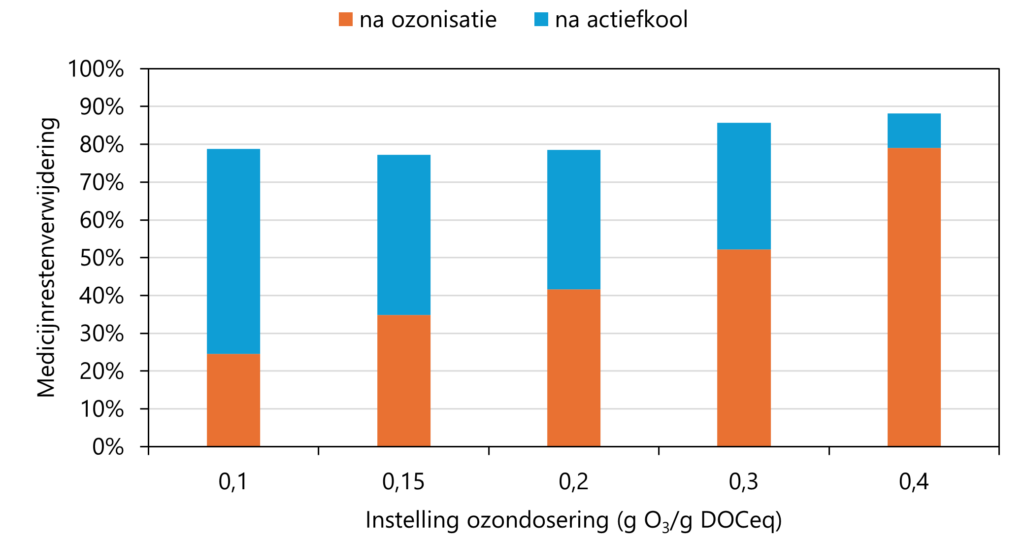
In Figure 1 the removal efficiencies at the different ozone dosings (orange) and after the biological activated carbon filtration are shown. On the basis of these results and results at reference plants in Switzerland, at WWTP Winterswijk a dosing of 0.15 g O3/g DOCeq. was chosen as starting point. In the course of time this can be adjusted on the basis of measurement results and operational experiences.
To comply with the requirements for pharmaceutical-residue removal, with a single ozone treatment usually a dosing of 0.3 to 0.7 g O₃/g DOCeq. is applied. This value however varies strongly per plant, depending on the contribution of the primary treatment. In Winterswijk BACF functions as main step in the post-treatment, while ozone is mainly deployed to extend the lifetime of BACF. Therefore lower ozone dosings were chosen.
From analyses it appears that at a higher ozone dosing more pharmaceutical residues are removed via ozone, but that the total removal hardly increases. This pattern is also observed at other post-treatment concepts and is thus not unique for Winterswijk: the techniques complement each other. This is positive for the breadth of the spectrum of pharmaceutical residues that can be removed and for the robustness of the system: if a treatment step (partly) fails the other step can take over the remaining share, without the total removal efficiency being put at risk. The high removal efficiency is partly explained because the activated carbon is fresh and much sorption (sticking) can still take place on it. In time also biological degradation is expected to play a role. Through this synergy between ozone and BACF a stable, efficient and future-proof post-treatment arises.
Co-current or counter-current ozone dosing
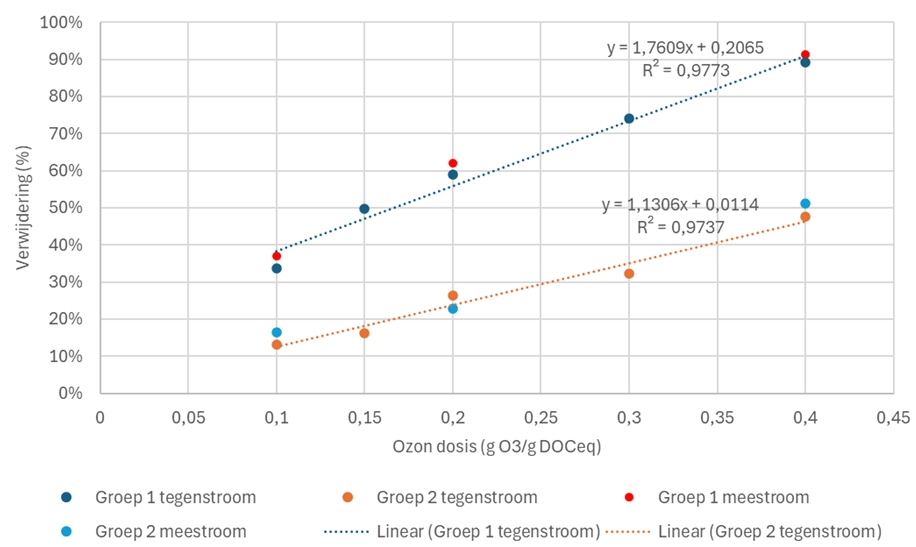
Ozone gas can be dosed with the flow direction of the water along or precisely against the flow direction of the water in [1]. Because the ozone installation at Winterswijk can operate with both settings, the removal efficiencies for both settings were compared (Figure 2).
Figure 2. Removal efficiency of the O3-BACF for different ozone dosings, calculated over all micropollutants. Group 1 are the guide substances known to be better removable than those in group 2
As can be seen in Figure 2, between the co- and counter-current principle no (significant) differences were found. Because counter-current is the up-to-now known and customary way of dosing, for phase 2 the counter-current principle was chosen.
Phase 2 results
The O3-BACF installation now runs almost a year with the chosen settings and the results are good.
Micropollutants
Of the eleven guide substances that serve as reference according to guidelines of STOWA and the Innovation Programme Micropollutants from Wastewater (IPMV), seven decrease significantly. Together the post-treatment installation and main treatment remove more than 90 % of the micros. To what extent the ozone extends the lifetime of the activated-carbon filter will only become apparent over time.
Until now, with roughly 18,000 treated bed volumes, no significant decrease in removal capacity of the BACFs is observed. It does appear from comparative analyses with plants without ozone that the removal efficiency now already persists longer: at conventional GAC filters a decrease is seen earlier and the lifetime at which pharmaceuticals are removed to a certain extent is 15,000 bed volumes. Moreover the combination of technologies removes a broader group of micros (Figures 3 and 4).
Figure 3. Average removals of all successful 48-hour samplings over the entire WWTP (n = 9)
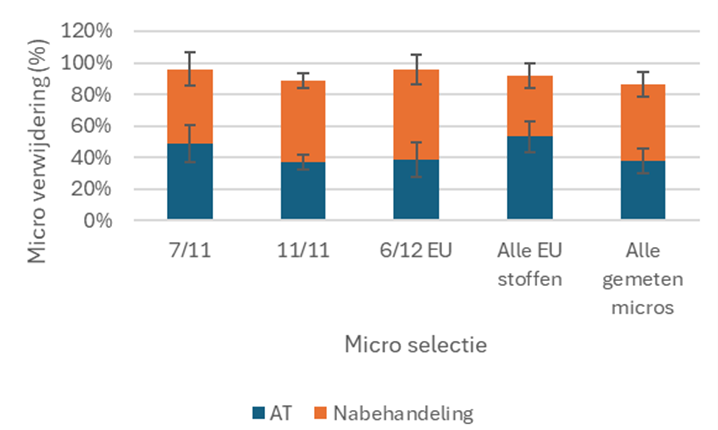
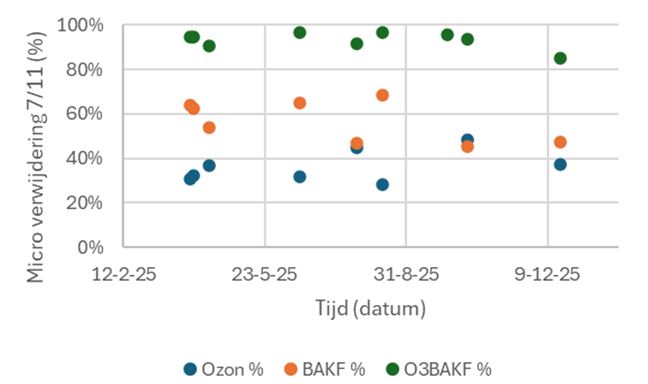
Figure 4. Removals per measurement day (48-hour samples, relative to effluent main treatment), calculated to 7 of 11 STOWA guide substances
Bromate and ecotoxicology
An important advantage of the combination O3-BACF is that the low ozone dosing and the buffering by BACF of any by-products limit the bromate formation. At WWTP Winterswijk therefore during the first year in operation no bromate above detection limits was measured after ozonation. The measured values always lay below the reporting limit which fluctuates between 0.1 and 0.5 µg/L. At the same time bioassays showed a clear reduction of ecotoxicological risks. On average the ecotoxicological effect decreased by 66 % relative to the water from the biological treatment (effluent secondary clarifiers). This lies well above the set target value of 50 %.
Ammonium and phosphate
Also the results for ammonium are positive. The oxygen content in the BACF was high and the biological processes started up quickly. Within one month after switching on the installation the ammonium concentration in the effluent dropped below the detection limit, despite the start-up in the relatively cold month November. At dry weather without bypass all ammonium is oxidized. At rain weather it is difficult to see what exactly happens, because the analyzer hangs in the effluent and thus also measures the concentration in the bypass. This makes it difficult to evaluate the results, but is logical from the perspective of the water authority.
Also the phosphate concentration of the effluent remains low with a limited coagulant dosing. The biological phosphate removal already works very well and usually achieves effluent concentrations below 0.5 mg-P/L as Ptotal (Ptot) in the effluent (apart from peaks at rainwater discharge). The combination of dosing and filtration in the post-treatment lowers the P-concentrations further. These seem until now to be around 0.15 mg-P/L as Ptot on the days on which sampling took place.
WRIJ has developed with municipalities a “smart pumping-station control” to keep the supply of wastewater as constant as possible between 250 and 860 m³/hour. This reduces both ammonium- and phosphate peaks. From the technological commissioning it has appeared that this control is of great value for the efficiency of the O3-BACF.
Conclusion
The technological commissioning of the post-treatment at WWTP Winterswijk has been successfully completed, with a good interplay between the smart pumping-station control and technologies: ozone (MicroOxi), biological activated carbon (BODAC) and coagulant dosing. The result is an improved water quality through efficient removal of pharmaceutical residues, a reduced ecotoxicological load and a better control of phosphate, ammonium and suspended solids. The bromate concentration remains in all measurements below the detection level.
The path to the future lies in continuation of the monitoring, aimed at further optimizing the dosings and backwash frequencies, and in training of operators. The coming months moreover further analysis will be carried out what the effects of this improvement are on the water quality of the Groenlose Slinge, on which the effluent is discharged.
Summary
WWTP Winterswijk commissioned at the end of 2024 a fourth treatment stepstep with ozone, biological activated carbon and coagulant dosing. This combination removes more than 90 % of the pharmaceutical residues, lowers the phosphate concentration and reduces that of ammonium to below the detection limit. Ecotoxicological effects decrease and bromate remains below the detection limit. The chosen low ozone dosing proves efficient and robust, partly due to synergy with activated carbon and a smart pumping-station control. The integrated after-treatment functions stably and future-proof and demonstrably contributes to better water quality.